




Introduction: Who Destroyed Nalanda University
Nalanda University, as soon as celebrated as one of the global’s greatest facilities of getting to know, holds a special place inside the history of training. Established in the 5th century CE under the Gupta dynasty, Nalanda became not just a university but a living hub of knowledge, attracting students from Tibet, China, Korea, Central Asia, and beyond. For centuries, it thrived as a beacon of highbrow pursuit in fields like philosophy, astronomy, arithmetic, remedy, common sense, and specifically Buddhist research.
However, its glory came to a tragic end in 1193 CE when it was destroyed by way of a military invasion. So, who destroyed Nalanda University, and why? Let’s dive deep into the records.
Table of Contents
The Rise of Nalanda University
Before talking about its destruction, it’s important to know what made Nalanda so significant:
- Founded in the 5th century CE by Kumaragupta I of the Gupta dynasty.
- At its peak, it had over 10,000 students and more than 2,000 teachers.
- Scholars came from across Asia, including Xuanzang and Yijing from China, who wrote extensively about Nalanda’s brilliance.
- The university had a massive library complex called Dharmaganja, divided into three large buildings:
- Ratnasagara (Ocean of Jewels)
- Ratnodadhi (Sea of Jewels)
- Ratnaranjaka (Jewel-adorned)
This treasure trove of manuscripts contained priceless works on Buddhist texts, Vedas, Upanishads, medicine, logic, mathematics, and astronomy.
Who Destroyed Nalanda University?
The destruction of Nalanda University is attributed to Bakhtiyar Khilji, a Turkic army commander of the Delhi Sultanate underneath Qutb al-Din Aibak.
The Event of 1193 CE
- In 1193 CE, Bakhtiyar Khilji invaded Bihar along with his navy.
- He attacked the Nalanda Mahavihara, mistaking it for a citadel because of its massive structures.
- His soldiers burned the great library, setting fire to manuscripts that had been preserved for centuries.
- Historical data indicates that the fireplace raged for months (a few bills say up to a few–6 months) because of the sheer extent of books.
The Impact of Destruction
The assault turned into catastrophic for the records of Indian and global information:
- Priceless manuscripts were misplaced for all time, such as works on technological know-how, medicine, and philosophy that had no duplicates.
- The Buddhist education machine in India suffered a massive blow, as Nalanda became its most prestigious studying center.
- The decline of Buddhism in India elevated after this occasion, although it persisted to flourish in Tibet and Southeast Asia.
Why Was Nalanda Destroyed?
The motives behind Bakhtiyar Khilji’s moves are debated:
- Religious variations – Some agree that Khilji, being a Muslim invader, noticed Buddhist establishments as symbols of different faiths and wanted to put them off.
- Military conquest – Others argue that he mistook Nalanda for a fortress and destroyed it as a part of his marketing campaign to enlarge control.
- Strategic dominance – By destroying Nalanda, Khilji weakened the local intellectual and cultural centers that could face up to his rule.
Timeline of Nalanda’s Journey
| Period | Event |
|---|---|
| 5th Century CE | Founded by Kumaragupta I (Gupta dynasty) |
| 7th Century CE | Flourished under Harshavardhana; visited by Xuanzang |
| 8th–12th Century CE | Continued growth under the Palas of Bengal |
| 1193 CE | Destroyed by Bakhtiyar Khilji’s army |
| Post-1200 CE | Gradual decline; never revived to its original glory |
Legacy of Nalanda
Even though the college became destroyed, Nalanda’s legacy lives on:
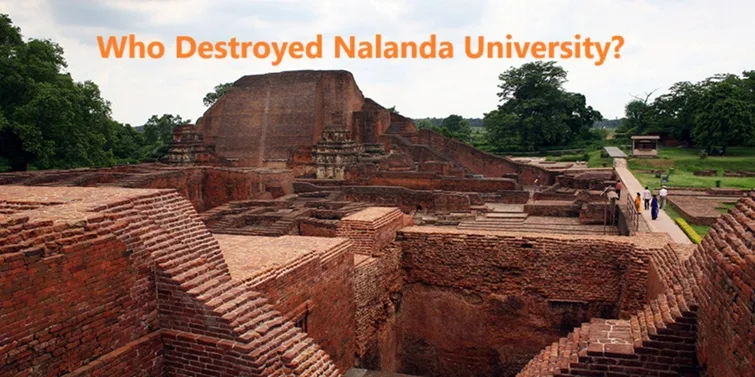
- The ruins of Nalanda in Bihar are today a UNESCO World Heritage Site.
- In 2010, a brand new Nalanda University was re-installed close to the ancient website, symbolizing the revival of its spirit.
- It encourages students globally as a reminder of India’s rich highbrow background.
Conclusion: Who Destroyed Nalanda University
So, who destroyed Nalanda mahavihara University? The answer is Bakhtiyar Khilji in 1193 CE. His invasion and burning of Nalanda’s great library marked the end of one of the world’s oldest and most prestigious universities. The tragedy reminds us of the fragile nature of knowledge and the importance of preserving it for future generations.
Nalanda was not just an Indian treasure but a global heritage of wisdom, and its story continues to inspire scholars and learners even today.
Also Read About:- Indira Gandhi Agricultural University: A Premier Institution for Agricultural Excellence